
Mandombe, lukasa: memory in signs
Long before the digital archive, Central Africa devised sophisticated devices for preserving and transmitting memory. Contemporary artists are reinvesting them.
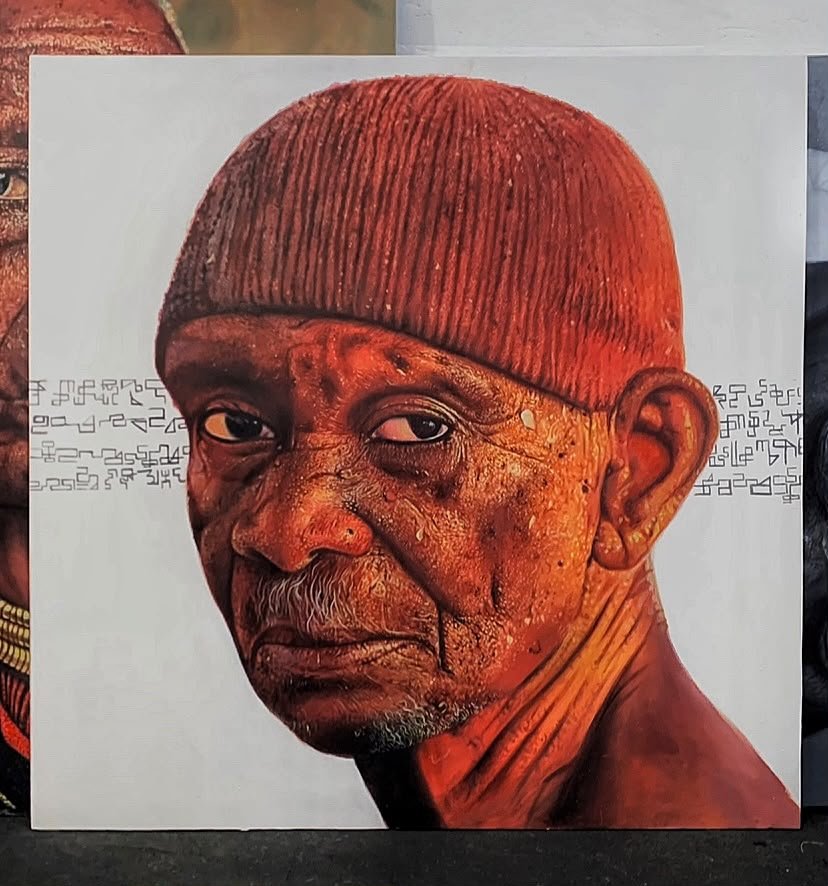
Documenting contemporary art also means tracing its lineages. Some of today’s works can only be fully understood in the light of older sign systems, designed to fix and transmit memory. Two of them, born in Central Africa, run through the painting of Benjamin Mbenga; le lukasa et l’écriture mandombe.
The lukasa, a memory you can touch
Le lukasa est une planche mnémonique en bois associée au royaume luba, dans le sud-est de l’actuelle République démocratique du Congo. Sa surface porte des perles, des coquillages et des motifs incisés. Entre les mains des membres de l’association mbudye, formés à sa lecture, elle servait à remémorer des récits, des généalogies, des lieux et des listes de souverains. Chaque élément, par sa position et sa forme, renvoie à une information; la mémoire y est spatiale.
Mandombe, a script of the 20th century
Mandombe is a writing system that appeared in 1978 in the Democratic Republic of the Congo, devised by Wabeladio Payi. Based on geometric forms, it is used to transcribe several Congolese languages and has been spread in particular by the Kimbanguist Church. It is a reminder that African graphic invention does not belong only to the past.
Dans ces œuvres, le signe s’archive.
When the sign becomes painting
Chez Benjamin Mbenga, ces systèmes structurent l’image. La géométrie de mémoire du lukasa et les signes du mandombe s’associent au portrait réaliste pour faire du visage une archive, un lieu où se négocient la souveraineté passée et l’urgence contemporaine. Sa série « Ancêtres Bibliothèque » le dit sans détour.
Cette démarche rejoint la vocation de la rubrique Empreinte, celle de suivre les archives, les généalogies plastiques et la documentation de la mémoire visuelle. Elle rappelle surtout que la modernité africaine ne se construit pas contre ses savoirs, mais avec eux.

Comments
Respond to this article
No comments yet
Start the discussion: share your reading of the article.